2026, Q4 Edition
Dear clients, colleagues and friends
Running EquitiesFirst for nearly 25 years doesn’t make me Milton Friedman or Warren Buffett. I never set out to be an investor in the conventional sense and I’m certainly not an economist or market analyst. We don’t try and call where economies and markets are going here. There are enough people doing that.
Instead, we do one thing at EquitiesFirst – providing asset-backed financing to clients – and we do it very well. That gives us a unique position on topics like demand for liquidity, where wealth is being created and how the financing market really works, beyond what you can read about on Bloomberg.
So I’ve decided to start this quarterly letter to shed some light on precisely these issues, which don’t get as much attention as they should and which I know are of interest to our clients.
Necessary fundamentals
It’s worth pointing out to start with that everything we see suggests that the US economy is healthy. Corporate earnings continue to be strong, with companies beating analysts’ earnings estimates on a regular basis. The banking system is robust and well capitalized, too. Most developed economies learned a valuable lesson from the 2008 financial crisis. With a stronger and better-capitalized banking system, I think that a re-run of that crisis is unlikely.
We are seeing the fruits of that solid economy across our global client base. Entrepreneurs are transacting with us who have created wealth across sectors including infrastructure building, aerospace, robotics, defense technology, life sciences and advanced manufacturing for processor and memory chips.
At the beginning of the conflict in Iran, clients were naturally uncertain about the future. Some paused their financing and investment plans for a time. But now we’re seeing a recovery in activity with pent-up demand coming through. Some clients are accessing liquidity to finance diversification into well-known companies, and those who borrow against digital assets are likewise often doing so to fund new investments in those markets. Others have been using our low-cost, fixed-rate capital to pay off more expensive floating rate debt during a time of higher interest rates.
Of course, many of our clients need capital for personal reasons, from buying property to paying tax bills. That flexibility about how clients deploy our loans has always been one of the biggest attractions to borrowing from EquitiesFirst.
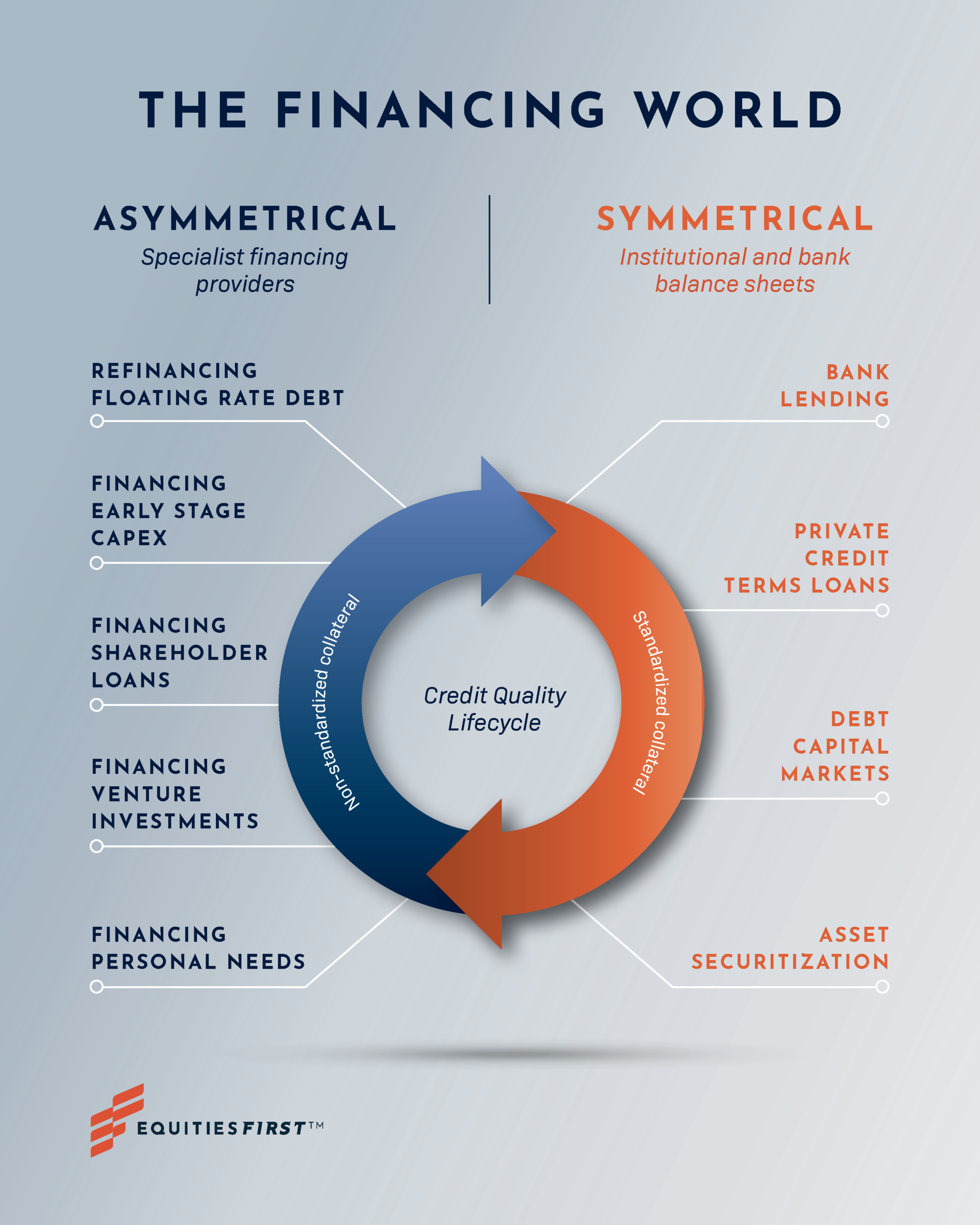
But demand for our kind of asset-backed financing is structural, not idiosyncratic. To explain why, I need to share a little of my thinking about how the financing market as a whole actually works. Basically, it’s a story of two worlds.
The Symmetrical World
First, there’s the Symmetrical World. Here you will find the unsecured loan and bond markets that serve large corporations and which are dominated by banks and asset managers. According to Bloomberg, the assets of listed banks globally are worth some $170 trillion and there are around $51 trillion of corporate bonds outstanding.[1]
There’s also secured financing. This includes the $16 trillion global repo market, where financial institutions borrow mainly against government bonds as collateral, and financing against abundant assets like mortgages and auto loans.[2] These assets can be packaged neatly into securitized bonds, rated and distributed far and wide to institutional investors.
The Symmetrical World is vast, liquid and transparent. You can read about pretty much everything that happens here in the financial media. Risks and returns are fairly clear, generally predictable and – well – symmetrical.
The Asymmetrical World
Then there’s what I call the Asymmetrical World. Here, all financing is secured. Borrowers generally don’t have direct access to institutional balance sheets. The amount they want to borrow probably isn’t big enough, they likely aren’t the right kinds of credits and the assets they can provide as security tend to be too hard to value for most lenders. Every borrower’s situation is different. Every asset is different. Every transaction is bespoke. There is no standardization.
The stocks or digital assets our clients have to borrow against can vary wildly in terms of trading volume and volatility. Change and rate of change are out of all proportion to the Symmetrical World. This part of the financing market is asymmetrical because the relationship between risk and return is not stable or predictable. Relative to the Symmetrical World, it’s illiquid and opaque, although much bigger. This is the world where we have delivered for our clients for 24 years – and which EquitiesFirst is proud to call home.
Lending in the Asymmetrical World is not well understood in the world beyond. But the truth is that the Symmetrical World depends on the existence of types of financing it cannot provide. To enter the Symmetrical World, an entrepreneur needs capital. Banks typically can’t help at an early stage. Venture capital, if it is available at all, can be dilutive and disruptive. Yet these entrepreneurs still need to get things done: backing new business ventures, funding capital expenditure, refinancing expensive debt.
The kind of progressive capital we provide helps to ensure that successful businesses and entrepreneurs progress from the earlier stages of the capital cycle and continue to enter the Symmetrical World. It’s no exaggeration to say that lenders like EquitiesFirst and our clients in the Asymmetrical World help to sustain Wall Street, institutional finance and capital markets. We likewise depend on the infrastructure of the Symmetrical World – especially capital markets and risk management tools – to operate. As has been said about America and Britain, we are two countries divided by a common language. We will never be the same, but we’re inherently related.
Stability by design
Our business model at EquitiesFirst is also different to those found in the Symmetrical World. Big financial institutions are owned by myriad shareholders and asset managers are beholden to their investors. By contrast, I own EquitiesFirst, and our approach to managing risk and generating returns is one that I developed decades ago and have been enhancing ever since I started the business. The evidence for this model is clear: we’ve always been able to provide liquidity when clients need it, and we’ve always returned their assets when the loans are repaid. This is stability by design for the Asymmetrical World.
I’m proud to say that 2025 was our best year ever and it looks like 2026 should be a record year too. Our pipeline has never been stronger and many of our clients have indicated to us that they will be transacting before the year end. Many of these will be returning clients: 60% of our business is repeat business. Another large percentage of our business comes from new clients who are referred to us by existing borrowers.
I think clients keep coming back to us and referring their friends because we have demonstrated for such a long time that they can trust us to do that one thing well. What we provide is flexible, low-cost and fixed-rate capital on generous loan-to-value ratios while allowing clients to retain exposure to the performance of their assets.
But what we enable is much more fundamental. We make it possible for our clients to meet their needs and achieve their ambitions without the kind of compromise involved in selling their core assets or taking out high-cost loans. That kind of financial freedom will always be attractive.
I’m looking forward to sharing more about how we operate in future letters. For now, though, what I can tell you is that the future for EquitiesFirst is very exciting. We love doing what we do and establishing these mutually beneficial relationships with our clients. So our top priority is simple: continue providing the best service possible combined with the lowest cost of capital for our clients. If we do that, we’ll also keep on giving our clients freedom by enabling them to meet their needs and achieve their ambitions without unnecessary compromises.
Yours faithfully
Al Christy, Jr.
[1] Retrieved from Bloomberg Professional, 31 August 2026
[2] Source: Financial Stability Board, FSB warns of financial stability challenges in repo markets, 4 February 2026, NB: figure only covers repo trades backed by government bonds