
By 2025, the world is set to generate more electricity from renewable energy than from coal – a major step on the road to a low-carbon future.[1]
Still, several other pieces need to fall into place to solve the decarbonization puzzle. The International Energy Agency (IEA) estimates that around 35% of emissions reductions needed to reach net zero by 2050 will need to come from technologies that have yet to be commercially deployed.[2]
Scaling up climate tech, therefore, is a historic investment opportunity. Yet accessing capital for these emerging business models remains a challenge because they are not yet cost-competitive. Take sustainable aviation fuel, which is about 2.5X more expensive than regular jet fuel.[3] Or green hydrogen, produced from electrolysis of water using renewable energy, which currently costs up to 12X as much as widely used gray hydrogen, produced using natural gas in a process that gives off carbon dioxide.[4]
Over time, costs are expected to decline rapidly as technologies scale. BloombergNEF forecasts green hydrogen will undercut gray in most of the world by 2035, for example.[5]
This mirrors the trajectory of renewable power. The global weighted average cost of solar and onshore wind energy plunged 89% and 69%, respectively, between 2010 and 2022.[6] That followed on from decades of steep cost reductions, which have made solar and wind cost-competitive with fossil fuels.
Figure 1: Costs of solar, wind, coal and fossil gas
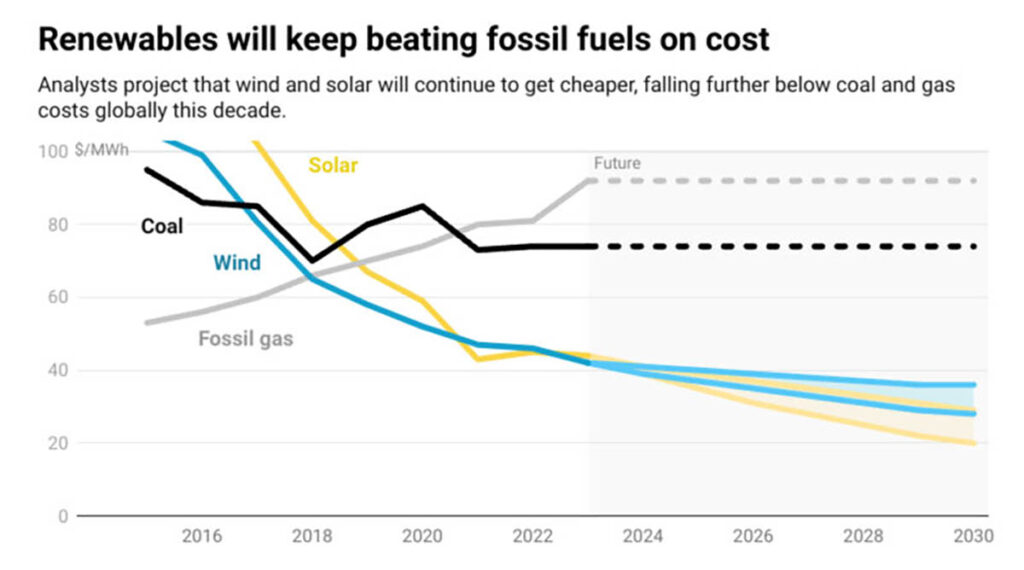
Image source: https://cleantechnica.com/2023/09/01/the-energy-technology-revolution-will-drive-renewable-energy-prices-even-lower/
Reaching those economies of scale, however, is only possible if more investment flows into the sector. That will require easier access to funding.
Funding climate tech
While early-stage investments may have been relatively easy to come by when interest rates were low, the change in the rate environment since 2022 has led to tighter liquidity conditions and an overall decline in startup valuations.
Across more than a thousand deals tracked by BloombergNEF in 2023, climate tech companies raised US$51 billion in venture capital and private equity funding, 12% lower than the previous year.[7] Many climate tech projects have reportedly been forced to shut down because of the harsher funding environment.[8]
Moreover, while venture funding is well suited for seeing startups through the initial – riskier – tech iteration phase of their journeys, when it comes time to deploy proven assets at scale, other types of funding are often needed.[9] These, too, have become harder to access following the adoption of tighter lending standards by traditional lenders. Even if banks are willing to lend, they typically impose onerous restrictions on how those funds can be used.
Compared to startups developing software, climate tech firms usually require significantly higher capital at early stages and often take longer to break even.
The ongoing difficulty in accessing funding could lead to several startups with viable technologies being unable to see them through to commercialization. In addition to potentially setting back the world’s climate objectives, this could lead to considerable foregone commercial opportunities.
All this points to a growing role for alternative capital, including private credit and specialty finance, in providing the flexible funding needed for business owners to accelerate their deployment of low-carbon technologies.
Emerging opportunities
Within the climate tech category, there are several opportunities worth highlighting for early-stage investors, according to PitchBook research. The main one is the carbon-tech segment, including carbon-capture startups and firms developing software for emissions measurement and accounting.[10] The next three most attractive segments are: electric vehicles, technologies to reduce emissions in the manufacturing process, and land use solutions to tackle sustainability in agriculture and forestry.
BloombergNEF, meanwhile, identified startups in three main categories in its latest Pioneers competition, with results announced in April 2024:[11]
- Relieving clean-power bottlenecks, primarily using software to identify the best sites for projects, deal with peaks and troughs in renewable generation and manage battery storage.
- Decarbonizing buildings with solutions to build or retrofit properties with more energy efficient systems for heating, cooling and lighting. Often, these can make living and working spaces more comfortable, too.
- New net-zero fuels, especially focused on aviation, shipping and long-distance trucking, which will be hard to electrify because batteries are not light or powerful enough to meet their needs.
Despite the risks involved in investing in these and other emerging climate tech, there is clearly strong return potential, especially given the likelihood that support for the climate tech sector – from governments[12] and businesses[13] – could ramp up significantly as the need to address climate change becomes more urgent.
In particular, as businesses face higher implicit costs of emitting greenhouse gases by way of carbon taxes – which are expected to surge over the coming years[14] – the value of technologies designed to reduce emissions will rise in tandem.
Ahead of that, however, even proven climate technologies are at risk of falling by the wayside because of the current funding situation. Specialty financing could help bridge the gap. Monetizing long-term shareholdings, for example, can give qualified investors an alternative source of funding for climate tech initiatives.
Given the scale of the global energy transition, it’s clear that every form of capital will have a part to play.
[1] https://www.scientificamerican.com/article/renewable-power-set-to-surpass-coal-globally-by-2025/
[2] https://www.iea.org/news/the-path-to-limiting-global-warming-to-1-5-c-has-narrowed-but-clean-energy-growth-is-keeping-it-open
[3] https://www.reuters.com/sustainability/us-sustainable-aviation-fuel-production-target-faces-cost-margin-challenges-2023-11-01/
[4] https://www.bloomberg.com/news/articles/2023-10-11/hydrogen-fuel-of-the-future-or-fizzling-climate-change-solution
[5] https://www.bloomberg.com/news/articles/2023-10-11/hydrogen-fuel-of-the-future-or-fizzling-climate-change-solution
[6] https://www.irena.org/News/pressreleases/2023/Aug/Renewables-Competitiveness-Accelerates-Despite-Cost-Inflation#:~:text=Between%202010%20and%202022%2C%20solar,the%20cheapest%20fossil%20fuel%20globally.
[7] https://about.bnef.com/blog/over-50-billion-flow-to-climate-tech-startups-in-a-stormy-year/#:~:text=Climate%2Dtech%20companies%20raised%20%2451,for%20all%20startups%20by%20Pitchbook.
[8] https://about.bnef.com/blog/over-50-billion-flow-to-climate-tech-startups-in-a-stormy-year/
[9] https://sifted.eu/articles/climate-tech-debt-financing
[10] https://pitchbook.com/news/reports/2023-vc-emerging-opportunities
[11] https://www.bloomberg.com/features/2024-green-tech-startups-bnef-pioneer-award-winners/
[12] https://www.weforum.org/publications/policy-action-to-mobilize-climate-finance-and-market-responses/
[13] https://www.weforum.org/impact/first-movers-coalition-worlds-largest-clean-demand-signal-climate-technologies/
[14] https://about.bnef.com/blog/carbon-prices-can-both-help-and-hinder-a-path-to-net-zero/